Pages

Wednesday, 16 September 2015

Korl... Kerl.. Koiln... Cologne. 9 things.

Let me give you a few quick facts about Cologne, that German city with a name I still struggle to pronounce in German (Köln).


1. It's not in France, which I had always thought when I was younger, because I thought all perfumes and the like came from France. Instead, it was an Italian man who created  the scent Kölnisch Wasser (Water of Cologne). It's still in production today. I didn't smell any. 

Inside the Dom
2. It has a famous and beautiful Gothic cathedral - or Dom - with two distinctive, steep and high towers that mark the skyline. The cornerstone was laid in 1248, and since that time it has weathered time, seasons, pollution, acid rain, bombs, and people, going through several repairs. Although the original stone is a pale much of it is dark now, blackened. It's an imposing building. It's impressive. Inside it's beautiful too, high ceilings and stone and wood and beautiful windows. We walked up the Dom - nearly 900m up narrow and winding staircases, with a stop along the way next to the bells (which then promptly went off; it was rather loud. Some people screamed in surprise. Not me) - and a view at the top. Which brings us to...

3. It's flat. Köln is so flat. Looking out, across the flat land from the tall belfry of the Dom, you really get a sense of how flat the flatness is. Well, there are some rises and dips of course but most of the area is just a flat plain. Which is partly because...

4. It's on the edge of the Rhine river. This is important for any city, and shapes it both physically and in terms of population and production. The Rhine runs 1,233kms from the Swiss Alps to the North Sea in the Netherlands. It's been a major highway for transporting all manner of things throughout history - merchandise, migrants, marauders, and just people trying to get from one place to another. It's wide, and smells a strange mix of saline mud and fresh air.


5. Köln has a Shokoladenmuseum, which includes a range of displays about the history of cocoa and chocolate production. It has everything - traditional methods of preparation of the cocoa nut, Mesoamerican figurines of reverence, trends and changes in the marketing of chocolate, a small but certainly working Lindt factory, and a shop. The mini factory was especially interesting, as it had half its guts exposed and you could watch the process of the chocolate being mixed and set in moulds, then turned out. I also rather liked the examples of chocolate brand and marketing, but cannot, from where I am right now, see myself eating chocolate called 'Cats Tongues.' No. Well, maybe if I tipped it out of the box and then left it there for a while so I could distance myself from the thought of eating the raspy pink tongue of a poor little kitten.

Cat's tongues. Mmmmm. It's a German thing.
A Roman mosaic in the museum
6. Romans were everywhere. You know Germany? They were all over that shit, back in the day. I had no idea. I mean, I knew, but I didn't really have any idea. The Romans were scarily present throughout so much of Europe (and other places). The Römisch-Germanischen Museum, very near the the Dom, is fantastic. I've already seen a lot of Roman stuff this year, but this was probably the best and most interesting collection of items - from another gorgeous mosaic still in the place it was uncovered in the ground, to statues, to tiny trinkets, to incredible glass jars that have lasted thousands of years and still look beautiful. We spent a long time in this museum. (NOTE: There was also a mustard museum, which we spent 1 minute in.)

7. There will be wasps. If there is sunshine, the wasps will be there. Especially around bakeries. And no one cares! If you bake it, they will come, and people will just eat the food anyway. I don't know how more people don't get stung.


8. Unsurprisingly, the main language is German. Most people also have some English, but there's no guarantee. People usually have a decent amount of a second language, but it may very well be French, or Italian, or something else strange and indefinable. I took an introductory German course earlier this year, so I knew how to say "Hallo!" and "Tsuss!" along with "Ya," "Nein" and could count to 12 if called upon. I was no great help. But it all works out well. No one seemed to care! I think we were a little like the wasps, getting mostly indifference and sometimes a little attention depending on where exactly we popped up. My favourite word: Partyfahrten

Floor in the Dom
9. Things are on the reasonable-cheap playing field. Especially if you've come from London, where everything is darn expensive (no matter what your boss who used to live in London says). Food is cheaper, clothes are cheaper, and a lot of the attractions are cheaper (see "reasonable") as well.


We went in late August, and booked our sleep at the Station Hostel, which was quite nice. It was a hostel. We had our own room, with a real bed in it, and a bathroom, and a little closet - a heck of a lot better than our previous hostel experiences. Although we couldn't get wifi from the hostel in our room, we could reach it from the Hostel bar so I could find some new music to listen on Spotify (and some old goodies). We spent a lot of time sleeping, actually, especially me. I have been so tired. The rain helped make some decisions for me, and because the Station hostel is right next to the train station in the centre of Cologne it was easy to duck back for a nap then head out again.

Then this one time, I drank an amazing hot chocolate. It was covered in cream. Oh man. That was good.


Thursday, 10 September 2015

Strathpeffer walks and Castle Leod

In the morning I skipped the church service to go for a walk. I have been known to do this.


I visited Eagle Stone. The Galic name is Clach an Tiompain, which translates as "Sounding Stone." That may not be as descriptive - the stone has an eagle carved into it, with a horse shoe above - but I like it better. It's a short walk above the village to find it, then along a small track edged by trees. The stone has been moved several times, and there's damage to it, but I think it likes where it's sitting now. It's peaceful in there, surrounded by trees, looking out over a gentle slope with a view of Knockfarrel at the end.

I walked up Knockfarrel, the site of another of those Pictish forts with a fantastic view and melted rock. The day was overcast, threatening to rain, but I often like that weather. It's certainly much cooler for walking. I took the same path as the day before but broke up through the ferns to the ridge line, to the edge of brown-green-purple bracken with tiny purple buds bursting, and the last bluebells of the season. I stood on the knock, greeting a man who was just leaving, and spent some time looking. I sat on the grass, near bluebells and bright yellow flowers and small ferns. You can't imagine how wonderful I found it just to be there, away from London for a bit, away from people, just myself  on a hill in the air in Scotland.


Knock Farrell
A view from the knock
I need to learn the birds of prey over here,
so I can recognise them.
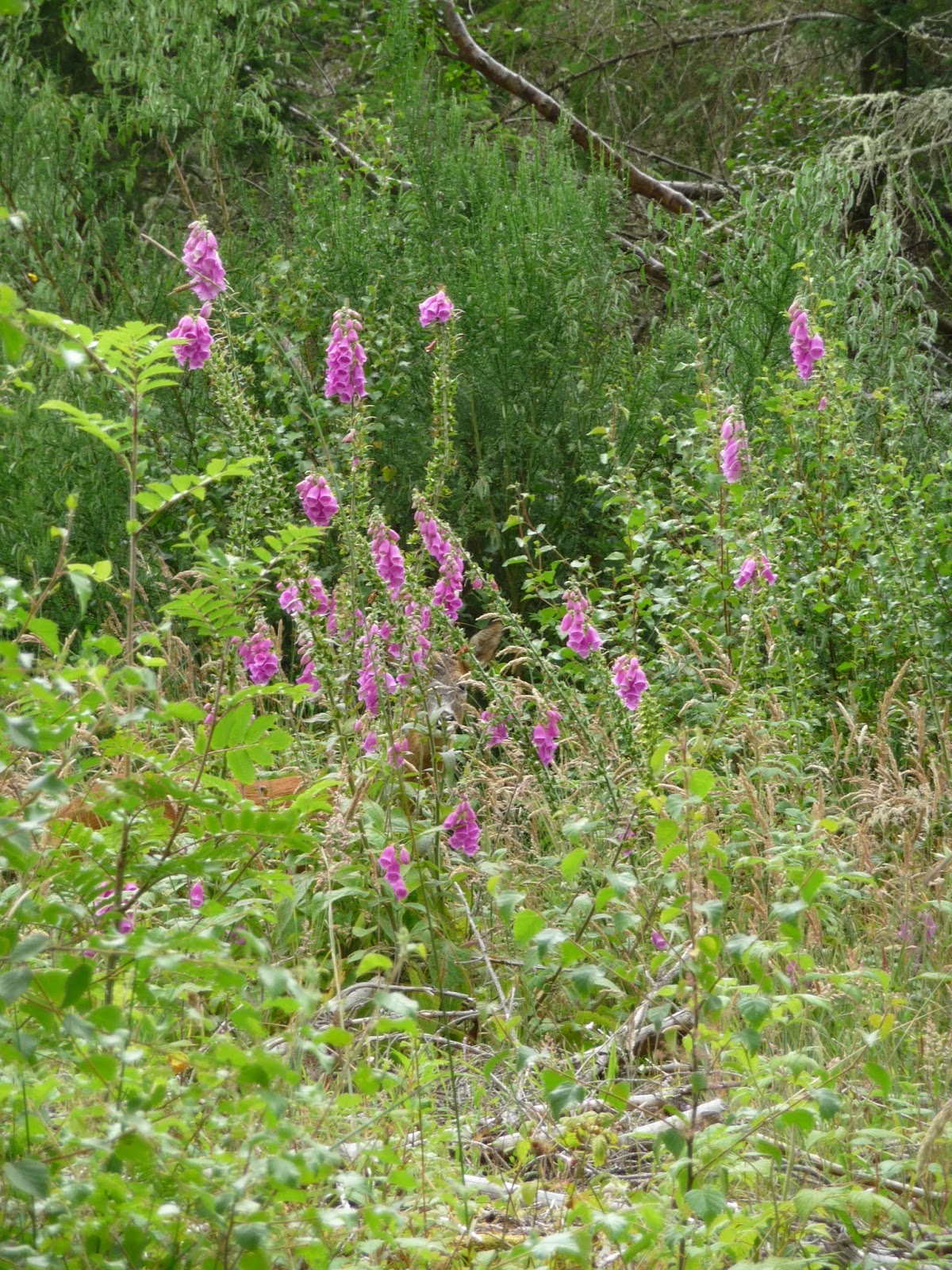
I took the ridge the other way, through the forest to Cnoc Mor. The view from there was obscured by young planted forest, which did not impress the walking man whom I bumped into again. We talked - he was from the area, from the Black Isle which is not an isle at all but a jutting out of land into the ocean, with Beauly Firth and Moray Firth on its south and Cromarty Firth to the North. I suppose he was in his late 50s or so, dark hair, Scottish accent, always wanted to go to New Zealand. We got covered in midges and walked down through the forest. He explained the difference between England's right of ways - one step off those marked tracks and you're breaking the law - and the freedom in Scotland to choose your own path (within reason; no wandering through gardens or fields in harvest). We parted out of the forest and I visited a disappointing Maze which I shall not go into (I didn't; it wasn't even a maze, just modern stones). But I did watch a bird of prey land in a tree, call, fly, and I started a small deer amongst the bracken and flowers.

Spot the deer! Not its name, a challenge.

We had lunch at the Pavillion in Strathpeffer, then went to attend a tour of Castle Leod, open to all MacKenzies. It always seems so peculiar to me, the two-half houses, part public and part private, the half you live and sleep in and the half you show off to strangers. Grandma, with her vast knowledge of the area's history and having stayed at the castle several times before, served as a tour guide for one of the rooms. She was enjoying herself.
I don't know when the castle was built exactly, except that it was well in place by the 15th century and looked relatively recognisable. It seems to have been built from stones long before, on a site where Vikings celebrated their conquest, perhaps on an old Pictish site. I think there were dragons involved at some point, not large dragons, but smaller, sleek and streamline forms. The modern history of Castle Leod is much better known, and has been lived in by the same family for over 500 years.

There's a story behind every picture on the walls, every map or piece of jewellery or weapon or book or elephant's foot arranged for keeping miscellany together. I particularly liked the story behind the portrait of a pretty young lady who once disgraced herself at a formal dinner (I believe some rather important people were there) by removing all her clothes and running down its length. Now, that's a saucy minx.


They're doing rennovations on the castle now, restoration, so there's scaffolding over the front. It's cold and old to live in a castle. There's up keep and history, and opening half your home. I would find it hard.


I was driven back to Inverness in the afternoon.  I was catching the Caledonian sleeper back, departing at 8.30pm and getting in at London around 7. I had purchased a pillow just for the occasion. I was in the cheap seats, not exactly vertical but certainly not horizontal, but I managed to snatch some sleep and was right and ready for a good Monday of work. But I won't leave you with that, but with Inverness. It's beautiful there, especially in the evening. I found my spot from last time while I waited for my train - my seat in the graveyard overlooking the river. It was sunny by then, that glorious rich afternoon sunlight. I ate a little food, then went for a stroll. The air was clear and the river was bright and flowing.


Sunday, 6 September 2015

Autumn, urban fox, Necrobus

For the first time in what seems like a very long time, we didn't have anywhere to go this weekend - no specific plans, no required travel, just a chance to do... well, stuff. Like washing, and buying a dressing gown after putting it off for ages because it seems like too much of a luxury, and watching some TV, and applying for some more jobs because I'm still trying to sink that one that's both permanent and will let me do a little more of the fun stuff.
Sunflowers in Holland Park


Autumn is starting. At first it was just leaves on the ground - I didn't see them fall, just found them lying there on the pavement underneath the tall green trees. But now I can see them changing on the branches, watch them spiral slowly down and drift down in a slow zig-zag. The temperature is dropping, although today was very warm and sunny. The light comes later, and leaves earlier.
Why is this area cordoned off? I don't know!
But there are autumn leaves on the ground.

But I'm enjoying this change, and I'm looking forward to autumn keeping on coming. Autumn has always been my favourite season. And I've had two summers, and although I'm not complaining about it (not in this blog, anyway) I'm looking forward to seasons again. And they will be quite distinct seasons here, I believe.

SAW A FOX, a London fox! He was not interested in speaking to me at all, even when I mentioned Fabian's name (just in case they happened to have been acquainted by relations of hearsay). He was more interested in attending to the contents of a rubbish bin, and glared at me when I approached and stepped underneath the trees when he realised I was staring. On discovering I wouldn't go away - I was determined for a conversation - he simply walked past me and down the street. I was scolded by M for being so rude, which I think is fair enough. No wonder the fox didn't want to talk to me.

Necrobus by day, courtesy Jozef Fekete
Last night, after spending the day mostly mucking about and watching Burning Love (a most entertaining parody of dating shows, which I do recommend to you highly), we decided to actually do something and headed over to Trafalgar Square. London is something worth seeing at night.

We decided to see some of it from the perspective of the darker history sidey of London - there's quite a lot of that, what with all the executions and prisons and murders and all the years to fit them into - by jumping on the Necrobus for a Ghost Bus tour. I know. These ghost tours can be horrible mistakes. They can be incredibly tacky or incredibly (awkwardly) serious. This one was not.

We were taken around inner London and shown the sights on the Necrobus, which used to carry people out to funerals and had further history that was divulged in an incredibly amusing and entertaining theatrical performance. And we got to see some of the sights at night, with deathly highlights pointed out. Do it. We both recommend it.

Later, we ate cake. Mmm.


View out the window this evening


Blogs posts to come
  • The Gathering II, briefly finishing up my trip to Strathpeffer
  • Germany - Cologne, Bonn, Achen
  • Luxembourg - beautiful
  • A cottage on the Welsh border - bats, owls, a bitey horse

Thursday, 3 September 2015

The Gathering

I have a particular fondness for Scotland, as those of you who know me will be well aware. It's a beautiful country, both soft and hard, rolling and jagged. It's a Romantic country, with hidden edges that aren't as romantic when you're there. And, for me, it's a part of family history and identity, and a personal link to and with people I love. In 2013 I visited Ullapool and the surrounding area, including Little Loch Broom where my great grandfather was born. Now I have visited Strathpeffer, more MacKenzie country and seat of Castle Leod, and it was quite nice to do so with my grandmother.


Every 5 years the MacKenzie Society of Scotland & the UK have an international Gathering - though they wouldn't kick an international out in another year, it's just a good excuse to try and round people up from across the globe. The Scots were a good bunch for immigration, both from an entrepreneurial spirit and, all too often, need. This year it means MacKenzies from the Netherlands, from Germany, from Australia; Canadian MacKenzie, French MacKenzies (who speak very little English), and 13 MacKenzies from New Zealand (or Aotearoa, if you're trying to beat the Australians in the MacKenzie Clan March around the field). I may have missed out a country or two though I hope not - forgive me if I did.

So on Friday 7 August I caught a train to Inverness from London. I left around midday and got in at 8.30. It was a long journey but there was some fantastic scenery, and it was all new - last time I came South to Inverness, not North. It was beautiful, as I expected. I would like to visit Aviemore and Pitlochry some time. I was also kept entertained (at times) by a small child who played peed-a-boo and then met some other children who had been constructing some animals from cardboard, and who gave him the gift of a blue fish.


This way to the village of Strathpeffer.
The Highland Games had been going all week, based in the castle grounds just shy of the small village of Strathpeffer, and there were a range of events organised. My grandmother and her friend were over in the UK, and attended many of these, from whiskey tasting to trips out and about. There were forts and castles and hills to see, and plenty of lunches and dinners. On Friday night there was a caileidh I was very sorry to miss - apparently Grandma impressed many with her dancing skills. She has always loved dancing.

I was met off the train by some of Grandma's friends, who stayed in her house recently while she was in Tasmania. They were wonderful. I bumbled off the train with my green backpack and wandered down - they were waiting at the end with a sign and a hug from each of them. They drove me to their house and a delicious pasta dinner they'd prepared for my late arrival, gave me whiskey and ginger ale, told me stories, offered me a bed. An old friend of my grandparents' who I had met before on occasions when he's visited NZ - think a stereotype Scot, no-nonsense, real Highland brogue all but impenetrable, passion for the languages of land - popped round. Then I went to a warm bed and slept, and in the morning was filled with sausages and bacon and toast and eggs and (oh yes!) black pudding. I am still so often taken by surprise by how hospitable and kind people can be. It's a marvelous thing. (So is a good black pudding.)
The tree planted for Grandpa in the MacKenzie castle grounds.

Grandma and her friend picked me up in their hired car (after joining breakfast for a wee kipper or two) and we drove the half hour or so to Strathpeffer, managing not to get too lost. We drove through Dingwall (lolz! What a name) and turned down a small straight road with trees planted either side - and there, then, was the entrance to the castle, being guarded by a handful of men in kilts on their way to the games. We were allowed through the gates - we were staying in the Castle.

In the grounds there is a field full of trees, some very old and large, and some new. One was planted for my grandfather - Poet, Lieutenant to the Caberfeidh, and Commissioner - in 2004. It seems odd that it's been so long. The tree is small but growing well.

Then the Games - with a fantastic pipe band playing at intervals throughout the day, walking around the feild surrounded by spectators MacKenzie and otherwise, and by stalls selling tartan and soaps and trinkets and various kinds of fast food. There were individual pipers playing in the corners all afternoon, dancers on the stage kicking their legs, competing for the best. A pit was set up for throwing things, the track prepared for runners and cyclists. I believe there was caber tossing, although I managed to miss it - I was walking up the hills, covering my shoes with mud and admiring the shapes and colours of the land. There were wild flowers in fantastic shades - those purples and yellows - grass in the paddocks heading up the hill, then ferns, suddenly, abruptly, on the other side of a stone fence.

Oh I do love a good piping band!
Colours I missed
Looks across farmland

There was a banquet. It was formal. I helped with the flower arrangements by running down to the stream and bringing back brown-tinged water, I ate food (it was good, and some of it involved salmon) and talked, I encouraged further creation of hats from the large red napkins we were given (it was a formal event after all). We retired back to the castle - and I must thank the Caberfeidh and his family again for letting me stay there - where I slept on an incredibly comfortable mattress on the floor and drank whiskey with Grandma and compainion while uselessly attempting to help with the crossword. I was never that good at crosswords. Or Scrabble. Too much pressure.

Did we down all the whisky? Did we ever finish the crossword? Find out in the next installment!


A gorgeous wee spider I found beneath a tree hundreds of years old.

Thursday, 27 August 2015

Roman remains, and eagles

I'm not that interested in their beaten gold necklaces, their large glittering rubies set in silver. I much prefer fragmented scraps of ancient leather sandals, a thin awl made of bone, the piled up remains of a midden. I get sick of the array of golden objects in museums. These items only give us just a small clipped part of their large, sprawling, messy story that we are, still, a part of, if only because we have the responsibility of telling it.

Old Roman mosaics because they are a mix of all these things. They tell us legends, they tell us about the people who lived in those places, and they tell us a little bit too about the history of an area based on how well they have survived, or not. Imagine all those feet that walked across those tiny carefully arranged stones, in their leather shoes, and why they walked where they did.

A farmhouse, on the way to the Lullingstone villa - perhaps, centuries away, someone will visit the foundations of this site,
shift through fragments of dinner plates and bathroom tiles and admire the peak of a leather cap.


The Lullingstone Roman villa in Eynsford, Kent, is fantastic. We went there on a gorgeous day and, after a false start, found our way along the road to a side track through some farmland. The upper fields were filled with golden wheat, the border trees were green. I could not help but think it idyllic.

The villa at Lullingstone, protected in the centre of the Centre. 
And it seemed, when we reached the villa visitor centre and had a look around inside, that it must have been that way for a long time - idyllic, pastoral, a place to want to live. With the river nearby, good soil in the ground, and a reasonably warm climate, it's long been a place humans have been. When the Romans moved into England it was one of the areas they settled, for a time.

The Lullingstone villa was built in the 1st century, and went through various expansions, modifications and occupations over hundreds of years until  it was destroyed by a fire sometime in the 5th. Today the foundations and parts of the lower wall remain, along with fragments of art and daily life. The story of the building suggests changes in architectural fashion, fortune and occupants, and culture. My favourite example is the pagan shrine where inhabitants could worship local water deities and spirits, which was later plastered over, the old niche in the wall filled in, suggesting a shift towards the worship of household deities in this cult room. Later still the space was altered to house a Christian chapel above, decorated with the Chi-Ro symbol and art that today graces the British Museum's walls. It's possible that, even with the chapel in place, pagan ritual continued in the cult room below.

I think the villa is best known for its mosiac, though. The site was rediscovered because of the mosaic when a farmer, digging a post into the ground, struck it.

The mosaic, from the British Heritage website.
The mosaic shows a scene from one of my favourite stories as a child - Pegasus. It shows Bellerophon riding on this magnificent creature, slaying the chimera, with the faces of the seasons and geometric patterns surrounding it. There are also some things that may be slugs with lion tails, I'm not sure, I just know I wouldn't have liked to meet them in the cult room or the chapel.

The detail is beautiful. It's amazing this could have survived so well, underneath the ground, underneath time, and kept its colour. The mosaic could be a demonstration of pagan worship, or an allegory for Christian values. It could be both. And as for why I loved the Pegasus story so much, I don't know. I never liked horses that much, unless they had wings or horns.

It was also interesting to be able to see some of the other odds and ends that were excavated from the earth around the villa, including skeletons and burial ware from the family tomb, carved marble faces of strangers, goose remains from a doubtless delicious feast near the kitchen, a tiny baby's bones that would have died too young to be recognised as a person or to deserve a resting place in sacred ground. Ten days, they say. That's how long you needed to live before you were human. It seems unfair, and tragic, but I think it's also practical, and a way of managing grief in a time where infant deaths were far more commonplace.

A view across to some of the displays, above the villa remains.
They also had on display a recipe for milk-fed snails (in modern script). I don't recall it exactly, but I know it involves soaking a vast quantity of snails in a bucket of milk until they are so swollen they just fall out of their shells. I think the next step is to eat them.

Later we went for a walk down into Eynsford itself, a small and idyllic village surrounded by trees and fields of livestock and golden wheat. I had never see a field of wheat before, somehow. It seems odd that I hadn't, when fields of wheat are such a staple of literature and Western diets.


We visited the ruins of an old Norman castle, near the edge of the river. There were flowers at the edge of the water, and bees everywhere.

And we discovered Eagle Heights because of a road sign, and visited that as well, managing to catch the end of one flight display and the entirety of another. It was well worth it. They are spectacular creatures, birds, and it's easy to forget it when you see them most days - little sparrows, thrushes, blackbirds. I like those birds, but birds of prey are something else. Some are huge and, as they fly above the crowd their wings brush your head and you are delighted but also glad to not be small. Some are so fast you are afraid as they wizz past your head they will crash through you like a bullet.

I had just read H is for Hawk by Helen Macdonald, and it was exciting to see some of these birds after just reading about training a goshawk.

The occupants of the Roman villa, whether Roman or Briton, must have sometimes kept birds of prey like these - probably not bald eagles, or fishing eagles, but peregrines perhaps - to hunt. 


Sunday, 23 August 2015

I O U

I owe you blog posts. It's just that weve been busy not only doing travel things, but general life things, like working and commuting and making dinner and trying to find a place to live more permanently. Then catching flights.


Currently we are in Luxembourg - on a boat cruise on the Moselle river as I write this, though I'll have to post it later in the hotel when I have teh internetz. Luxembourg is in one side of the river, Germany the other. Its a sunny day. We are in wine country.

We have been to Kent, and seen Roman villa remains and birds of prey and a castle.

We went to a Greek play in Islington.

I went to the MacKenzie Highland Games in Stathpeffer with my grandmother - every five years they have an international gathering, and this year there were 13 from NZ. It was fantastic to be in Scotland again, and to go to a new part of it with some of my history. And, of course, to see the tree planted for my grandfather on the castle grounds.

I have been fighting tube strikes by working from home where possible. I have been reading lots of books.

We went to Cologne in Germany last Saturday, exploring that city and taking day trips to Bonn and Aachen. We took the train to Luxembourg on Friday morning. And now it is time to continue looking around - mostly, at the moment, at rows of vines going up Luxembourgish hills and across German flats.

Tuesday, 11 August 2015

Legend tells of a lost operating theatre

I want you to picture Raymond Russell in the mid 50s. He's of a medium-height, English, with a pair of rounded glasses and an impressive Doctorate in History. He's sitting in the Archives, probably at Kew - rows and rows of old information, books to ceilings, at a small table with papers spread out. He makes notes in a long scrawl that runs nearly off the edges of his spiral bound notebook. At least, that's how I like to picture him.


Legend tells of a lost operating theater - but quietly, only to those who take the time to listen. Dr Raymond Russell listens because he is researching the history of St Thomas' Hospital. When St Thomas relocated to Lambeth in 1862, all the entrances to whatever herb garrets and operating theaters for women it may have contained were blocked up. Time passed. The people who knew about it kicked the bucket - though papers, those very same papers Russell was poring over, kept its secrets.

Russell decided to investigate in St Thomas' Church, which still stood and had been part of the original hospital. He looked first to the ground, for a secret basement operating theater, and found nothing. He looked next to the high space above his head in the rafters of the church. One story tells that he climbed up into a space in the attic, stepping out into an old empty wooden space, dusty and dank, where some corners still held dusty dried herbs. Another says that he broke through the church wall into the theater itself, disturbing a century's worth of dust to rediscover what instantaneously became the UK's oldest known operating theater. Either way, all was completely dark - the skylight replaced long ago by slates and all other windows blacked over with smog and dirt.

Imagine Raymond Russell's torch going dramatically out as he came into the room, pulling out the matchbook he got from St George's pub, and lighting the space with long vague shadows that trembled under the thin weight of his breath on the flame.


Today the operating theater and the herb garret have been made into a marvelous, small and quirky museum. You can follow a set of tight winding stairs upwards to pay at the desk before one more (less winding) short journey to the entrance of the garret. You will discover an assortment of herbs and fragments of animal - and some recipes - reflecting medieval health care. There are displays showing some of the tools used in early surgery, which will fascinate you and make you very glad for advances in medicine and science. There are a few slivers of liver and a chunk of preserved human brain.

There are dried opium poppy heads, which the stories said were found in the rafters soon after Russell rediscovered the space, but where actually found by someone called in to do pest control in the 50s. As you might imagine, after a century of being left to their own devices, there was a thriving community of furry and scaly creatures up there. He discovered there were layers of floor boards - the doctors of old were no carpenters and, when old boards started to rot, they simply built over them - and discovered the poppy heads down underneath them. The museum knows this, because the man himself showed up a couple of years ago and identified the dried poppy heads (which he had varnished! Never varnish an archaeological find! Not even in the 50s). He was apparently quite delighted to see them there, and to see the space had been so well used.

And there is, of course, the operating theater itself. It dates from 1822, when part of the herb garret was converted to provide a space for women in need of surgery (or help producing babies, which looking at some of the implements they once used to "assist" this process was very akin to the surgery of the day). In the 1800s, your chances of surviving surgery (possibly childbirth) were 50% on a good day.


So now you need to imagine yourself in a small wooden room, lying on your back on a slab of wood. There is a skylight above you to let in natural light, and candles posted around the room to add a little more. Around you, rising up like a small amphitheater, are rows of benches. These are all occupied by curious and eager men wearing the garb of student doctors, toting whatever scrolls and notepads they took to such sterling opportunities to observe a master at work.

You are most likely tied down, especially if you have damaged a limb (they will either need to amputate this, or dis- then relocate it) or have some kind of internal trouble (they will need to open you up) or, well, anything really. You're tied down. But they've given you opium to help ease the pain you're currently experiencing, because it's about to get a helluva worse. On the table beside you are a variety of saws in different sizes, some scissors, a selection of knives with different edges, and a whole collection of instruments for grabbing and pulling and twisting. They are all incredibly sharp and all very silver and shiny. 

They don't stay shiny for long.